Not Applicable

Not Applicable

R4VES

Component is required for safety critical systems
Nein
Target TRL at the end of phase 1
TRL4: Versuchsaufbau im Labor --> Plattform mit Parametrisierung
Target TRL at the end of phase 2
TRL6: Prototyp in vereinfachter/simulierter Einsatzumgebung --> Anwendungsfälle

R4VES is an automation and configuration tool for simulating RISC-V Software-based Self-Tests (SBST) using different fault models (Stuck-At- / Transition-Delay- and Cell-Aware Faults).

Status
Visibility
Publicly available!

Next Craig Interpolant Prover (NCIP)

Component is required for safety critical systems
Nein
Target TRL at the end of phase 1
TRL4: Versuchsaufbau im Labor --> Plattform mit Parametrisierung
Target TRL at the end of phase 2
TRL6: Prototyp in vereinfachter/simulierter Einsatzumgebung --> Anwendungsfälle

NCIP is a Bounded Model Checker (BMC) for solving formal problems in various input formats (AIGER / CNF). Using Craig interpolants it is able to prove unreachability for some formal problems that can be validated via generated unreachability certificates.

Status
Visibility
Publicly available!

Cell-Aware SPICE Simulation

Component is required for safety critical systems
Nein
Target TRL at the end of phase 1
TRL4: Versuchsaufbau im Labor --> Plattform mit Parametrisierung
Target TRL at the end of phase 2
TRL6: Prototyp in vereinfachter/simulierter Einsatzumgebung --> Anwendungsfälle

Cell-Aware SPICE Simulation is a tool to simulate defects in library cells to generate cell-aware fault models.

Status
Visibility
Publicly available!

Reconfigurable Scan-Network Insertion

Component is required for safety critical systems
Nein
Target TRL at the end of phase 1
TRL4: Versuchsaufbau im Labor --> Plattform mit Parametrisierung
Target TRL at the end of phase 2
TRL6: Prototyp in vereinfachter/simulierter Einsatzumgebung --> Anwendungsfälle

Reconfigurable Scan-Network Insertion is a tool for creation and insertion of Reconfigurable Scan Networks (RSN) with flexible configurations and structural circuit modifications.

Status
Visibility
Publicly available!

riscv-etrace

Component is required for safety critical systems
Nein
Target TRL at the end of phase 1
TRL1: Beobachtung und Beschreibung des Funktionsprinzips
Target TRL at the end of phase 2
TRL3: Nachweis der Funktionsfähigkeit --> Plattform ohne Parametrisierbarkeit

Decoder and tracer for RISC-V E-Traces

This library provides a decoder and a tracer for the instruction tracing defined in the Efficient Trace for RISC-V specification. It provides:

Status
License

This library is licensed under the Apache License 2.0.

Visibility
Publicly available!

UPEC: Formal Security Verification

Image
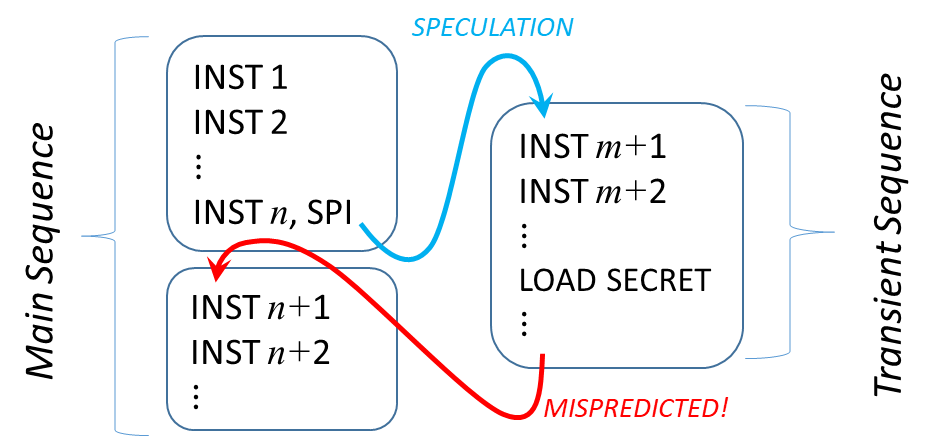
Speculative program execution can enable side channel
Component is required for safety critical systems
Nein
Target TRL at the end of phase 1
TRL6: Prototyp in vereinfachter/simulierter Einsatzumgebung --> Anwendungsfälle
Target TRL at the end of phase 2
TRL6: Prototyp in vereinfachter/simulierter Einsatzumgebung --> Anwendungsfälle

Figure: Speculative program execution can enable side channel

Status
Visibility
Publicly available!

Moonlight

Image
Moonlight
Component is required for safety critical systems
Nein
Target TRL at the end of phase 1
TRL6: Prototyp in vereinfachter/simulierter Einsatzumgebung --> Anwendungsfälle
Target TRL at the end of phase 2
TRL6: Prototyp in vereinfachter/simulierter Einsatzumgebung --> Anwendungsfälle

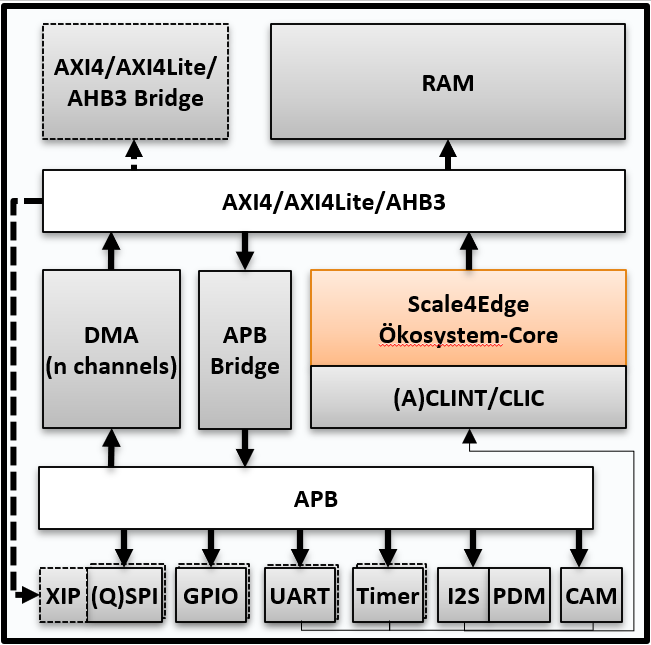
Moonlight is a subsystem around a TGC core developed by MINRES. The Good Core (TGC) [1] is a highly flexible, scalable and expandable RISC-V processor core and the TGC variant to be used in the subsystem is configurable.

Moonlight contains a configurable APB3 subsystem with a customizable number of different peripherals, e.g., GPIO, UART, Timer, SPI, I2S Receiver, DMA.

Status
License

Send an email to eyck@minres.com

Visibility
Publicly available!

QTA - QEMU Timing Analyzer

Component is required for safety critical systems
Nein
Target TRL at the end of phase 1
TRL5: Versuchsaufbau in vereinfachter Einsatzumgebung --> Optimierte Plattform
Target TRL at the end of phase 2
TRL5: Versuchsaufbau in vereinfachter Einsatzumgebung --> Optimierte Plattform

The QEMU Timing Analyzer (QTA) is a QEMU plugin which extends QEMU for the time annotated execution of binary programs. QTA has been tested only for RISC-V and TriCore. As the implementation extends QEMU through TCG plugin API it should be compatible with any other ISA and all future QEMU versions . QTA comes with a frontend that can import output files from AbsInt aiT WCET analysis.

Status
License

The source code of the QTA plugin is freely available with the front end for AbsInT aiT file import at github under: https://github.com/hni-sct/qemu-qta.

Visibility
Publicly available!

eVerify HW/SW Co-Verification Framework
Image
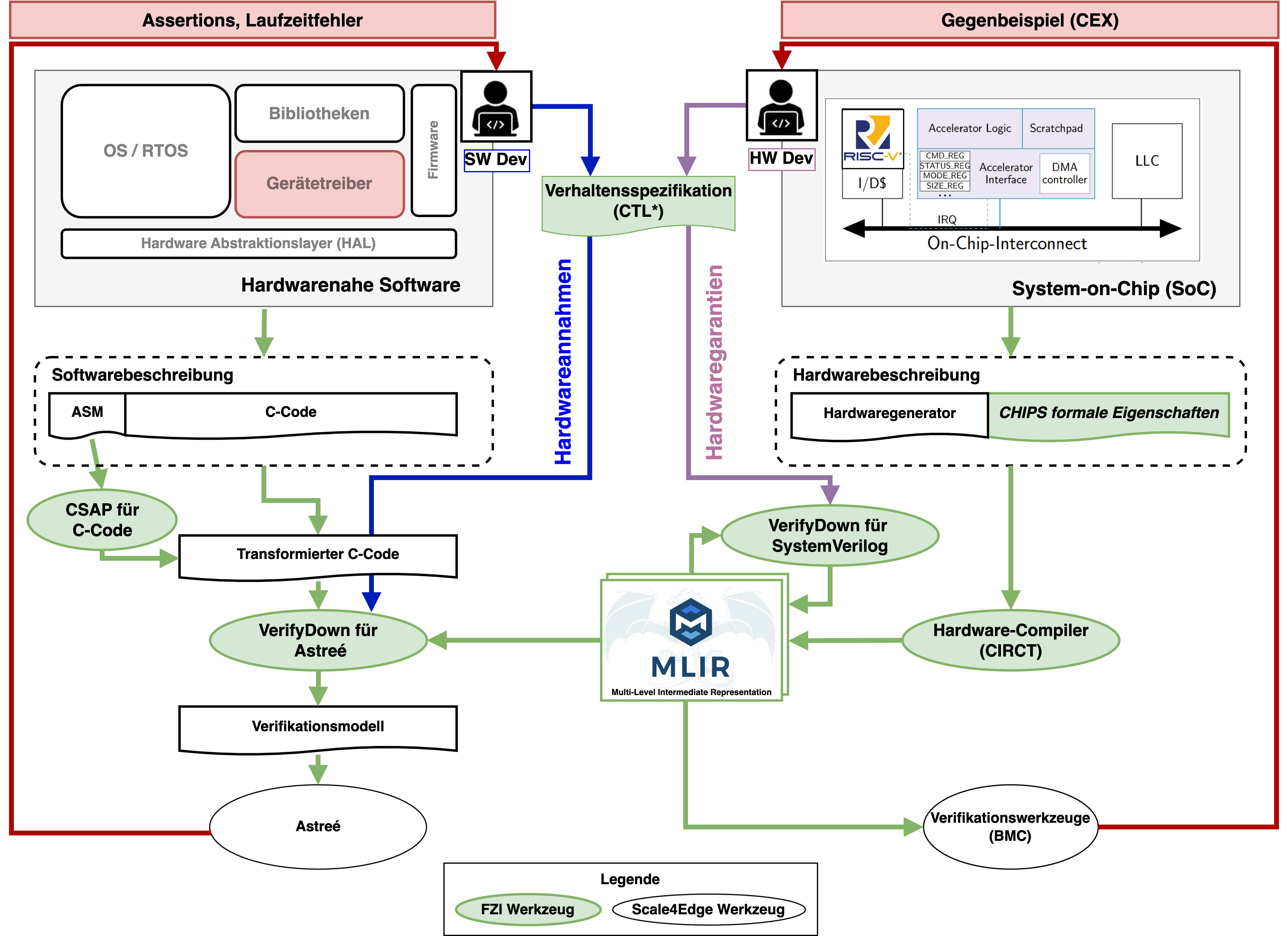
eVerify Workflow
Component is required for safety critical systems
Nein
Target TRL at the end of phase 1
TRL3: Nachweis der Funktionsfähigkeit --> Plattform ohne Parametrisierbarkeit
Target TRL at the end of phase 2
TRL4: Versuchsaufbau im Labor --> Plattform mit Parametrisierung

The eVerify framework supports formal software verification by considering the hardware behavior of loosely coupled devices, e.g., peripherals.

This is achieved using the Behavioral Description (BD) based on CTL* to specify hardware behavior from the software point of view. Based on the BD specification, the tool verifyDown generates assumptions/assertions for the hardware description and the software driver code.

Status
Visibility
Internal for Scale4Edge partners only!

CDR (Clock and Data Recovery) ecosystem component

Component is required for safety critical systems
Nein
Target TRL at the end of phase 1
TRL3: Nachweis der Funktionsfähigkeit --> Plattform ohne Parametrisierbarkeit
Target TRL at the end of phase 2
TRL4: Versuchsaufbau im Labor --> Plattform mit Parametrisierung

The CDR is a an analog ecosystem component that implements in a high speed serial data input interface. The CDR extracts clock information from the serial data stream and retimes the data. Combined with deserializers & serializers it provides high speed memory I/O access of several Gbps. In first designs the CDR applies NRZ coding validated in 22FDX and IHP 130nm technology. Later designs will be optimize for PAM4 encodings.

Status
Visibility
Internal for Scale4Edge partners only!