Not Applicable
PLL (Phase Locked Loop) ecosystem component
The PLL is a component of the Scale4Edge ecosystem that generates a high frequency clock output (>1 Ghz) from a low frequency clock input signal. The output frequency is a scalable multiple of the input frequency and configurable at runtime. The PLL was designed with analog subcomponents in a first step. It will be optimized at system level as a synthesizable digital PLL in further steps. The designs are mainly validated by tapeouts in 22FDX technology.
MLonMCU
While there exist many ways to deploy machine learning models on microcontrollers, it is non-trivial to choose the optimal combination of frameworks and targets for a given application.
Thus, automating the end-to-end benchmarking flow is of high relevance nowadays. MLonMCU allows performing complex benchmarks of edge ML workloads, frameworks and targets with minimal efforts
Apache License 2.0
UMA: Universal Modular Accelerator Interface
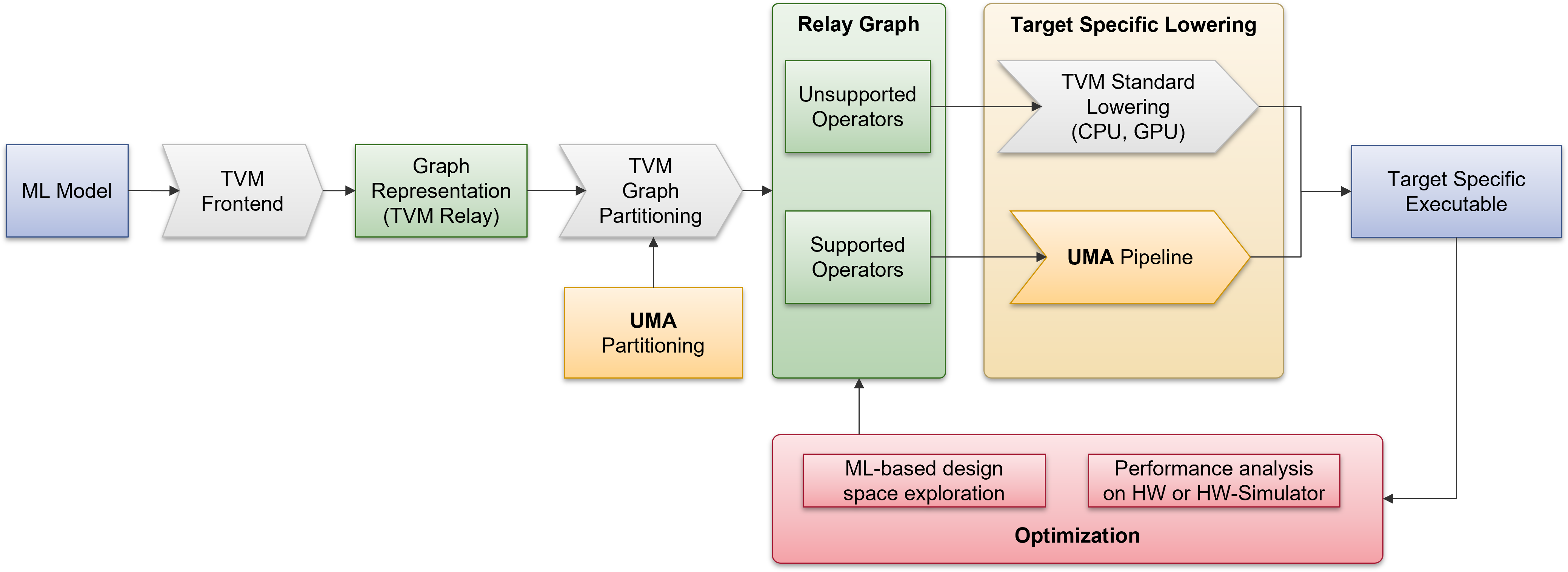
UMA (Universal Modular Accelerator Interface) is a unified infrastructure for easy integration of external hardware accelerators into the machine learning compiler framework TVM. UMA provides file structures, Python interface classes and a documented API and is available open-source in the latest releases of TVM.
Apache License 2.0
Formale Security Analyse (UPEC)
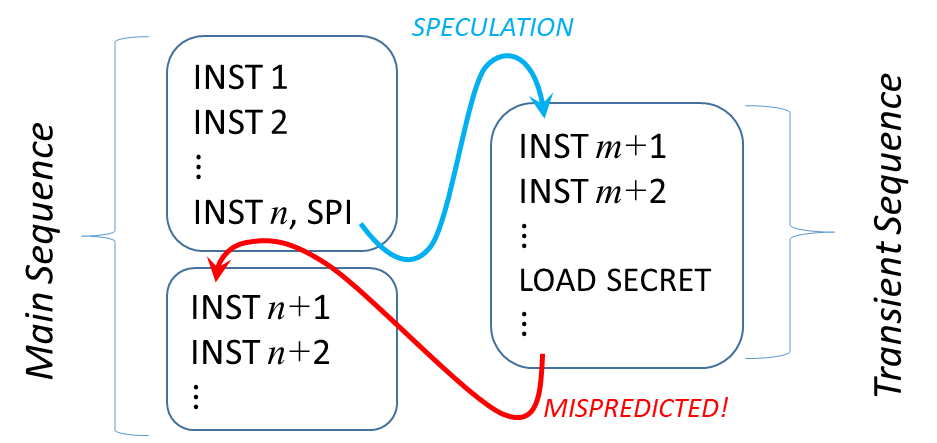
Abbildung: Spekulative Programmausführung kann Seitenkanal ermöglichen
SpiNNedge DSP/AI Accelerator
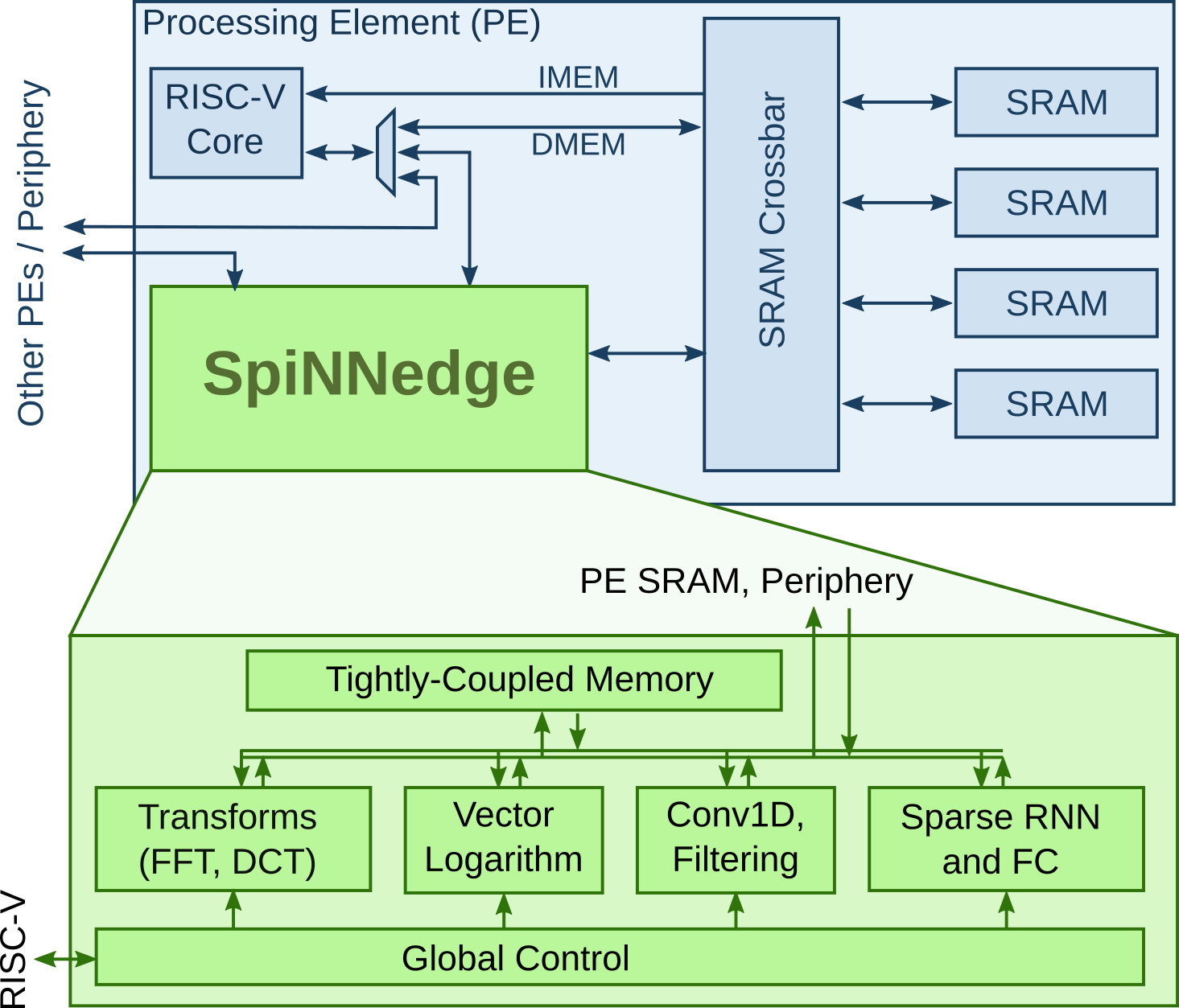
The SpiNNedge accelerator is designed for ultra-low-power processing and classification of time series from sensors in real time. It combines DSP functions for data preprocessing and feature extraction (frequency transforms, windowing, filtering, logarithm) with classification based on recurrent neural networks (RNN). The RNN module exploits sparsity for significantly reduced storage and processing effort. The accelerator performs individual processing layers autonomously. Complex layers can be flexibly assembled from base operations via a global control module.
HighRel Multiprozessor
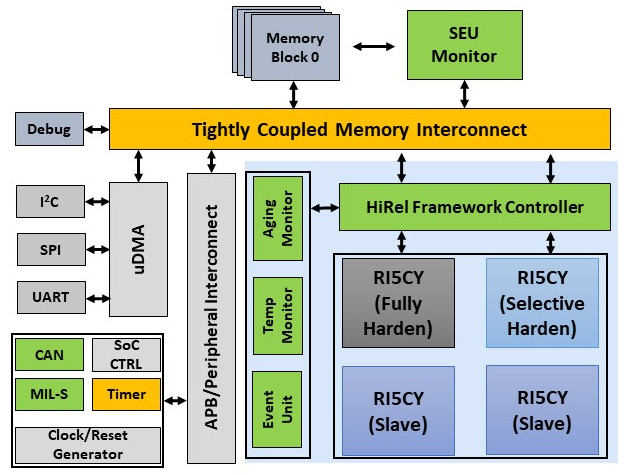
The HighRel Multiprocessor is a Pulpissimo-based quad-core processing system that is specifically built to withstand the harsh environments as they occur in avionics or astronautics. Based on the required processing power as well as different health and environmental monitors, the system is able to autonomously configure itself to various states of fault tolerance (DMR, TMR or QMR) or performance (low power or high performance).
Drawing Engine Nlview
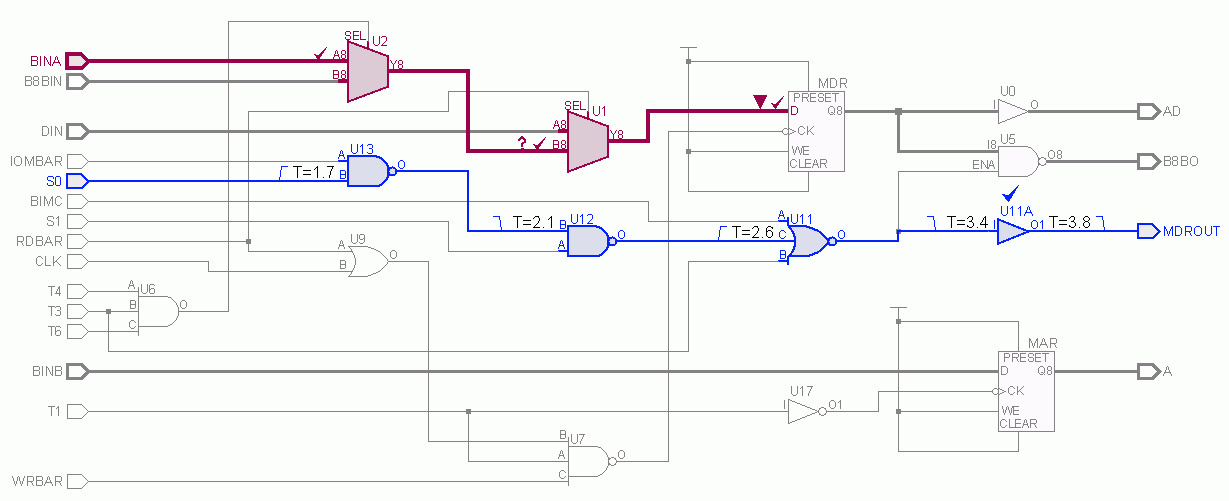
Altair Engineering's Nlview® engine provides automatic generation of interactive schematic diagrams for different levels of electronic circuits, including gate-level, RTL and block-level. Optional engines are available for the system-level (S-engine), for the transistor-level (T-engine), and for automotive and aerospace applications (E-engine).
Commercial licenses can be obtained from Altair Engineering.
CHIPS Verification Framework
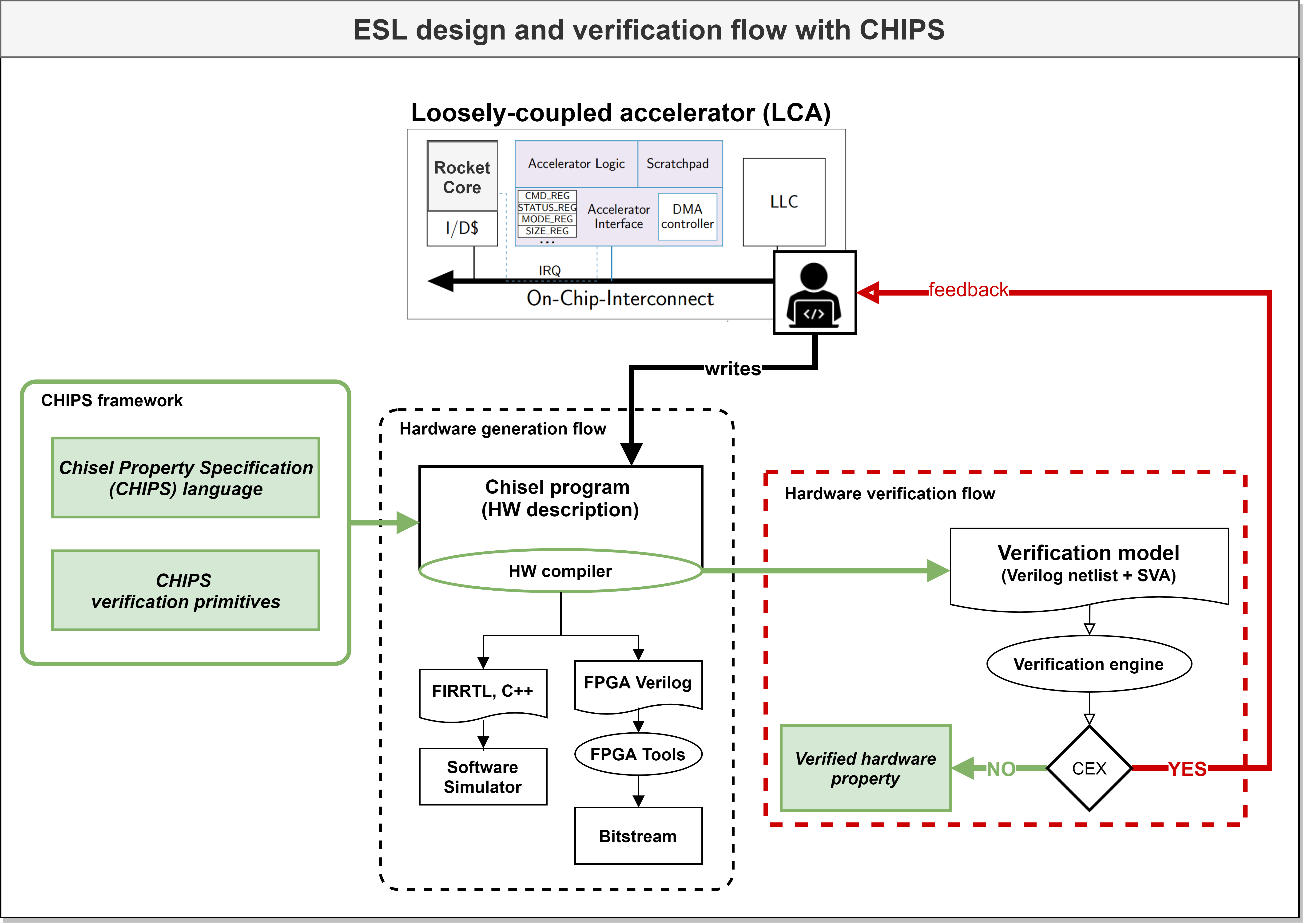
The CHIPS Verification Framework is a collection of tools and libraries for (formal) hardware design verification. The framework encompasses two subprojects:
CHIPS: Chisel Hardware Property Specification Language
The foundation of the CHIPS-VF is a domain-specific language (DSL) embedded in Scala that allows the specification of lightweight verification properties on different levels of abstraction using the assertion-based verification paradigm.
Extended CIRCT Hardware Compiler
On Chip Debug Solution

Lauterbach implements debugging and trace support in alignment with Partner Infineon specific Hardware Solution.
The Solution will be part of Lauterbach's commercial RISC-V Debug Tools
tflite_micro_compiler
Generate tflite micro code which bypasses the interpreter (directly calls into kernels)
Basically this code uses a fully set up tflite micro instance to dump the internal allocations and function calls assigned to the model, then dumps the tensor and node settings into a compilable file, eliminating the need for running the interpreter at each program start and for resolving the correct kernel at run time.
Apache License 2.0